
Amphibian fencing (temporary amphibian fences) is a continuous barrier that keeps toads, frogs, newts and reptiles off roads and out of working areas while they migrate. Set up for exactly this seasonal phase, our MAIBACH mobile fence is removed again once migration is over. Since 1993, we have worked in amphibian protection and developed technical standards for these systems together with specialists. For temporary amphibian fencing, also known as a toad fence or, in the UK, as newt fencing, you can choose between two versions: robust and light.

Basically, the fence is a freestanding construction of sheeting or woven fabric held by galvanised steel posts at intervals of 2 metres for the robust version and 1.75 metres for the light version. At the top, an overhang angled at 45° stops animals from climbing over the barrier. For stability, lateral guy ropes and pegs brace the line. Along the fence, pitfall buckets with drainage holes collect the animals so that helpers can carry them safely across the road.
Just as important is a tight seal at the bottom. Depending on the system, the skirt rests on the ground or is buried. As an alternative to digging, our own ground anchors press the skirt firmly onto the soil, with three anchors recommended per 2 metres. This way, animals cannot slip underneath.
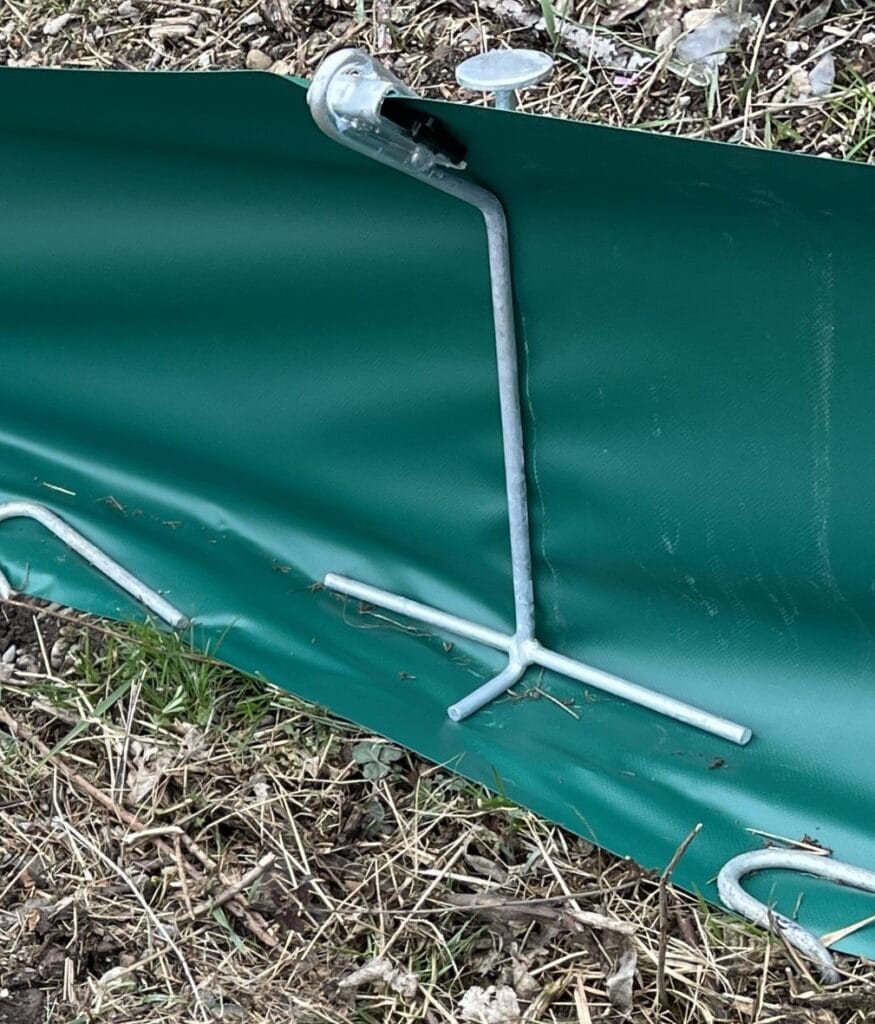
Both versions can be installed freestanding with galvanised steel posts or attached to an existing fence with wire rope. Both meet the criteria of M AQ 2022, the German guideline for wildlife crossings on roads. In terms of material, fence height and roll length, however, they differ clearly, as the following table shows.
| Version | Fence height | Roll length | Post spacing |
|---|---|---|---|
| Robust version | 60 cm | 50 m | 2 m |
| Robust version | 70 cm and 80 cm | 70 m | 2 m |
| Robust version | up to 100 cm* | on request | 2 m |
| Light version | 59 cm | 24.5 m | 1.75 m |
* Fence heights above 80 cm are a special production that we do not hold in stock, so they come with longer lead times.
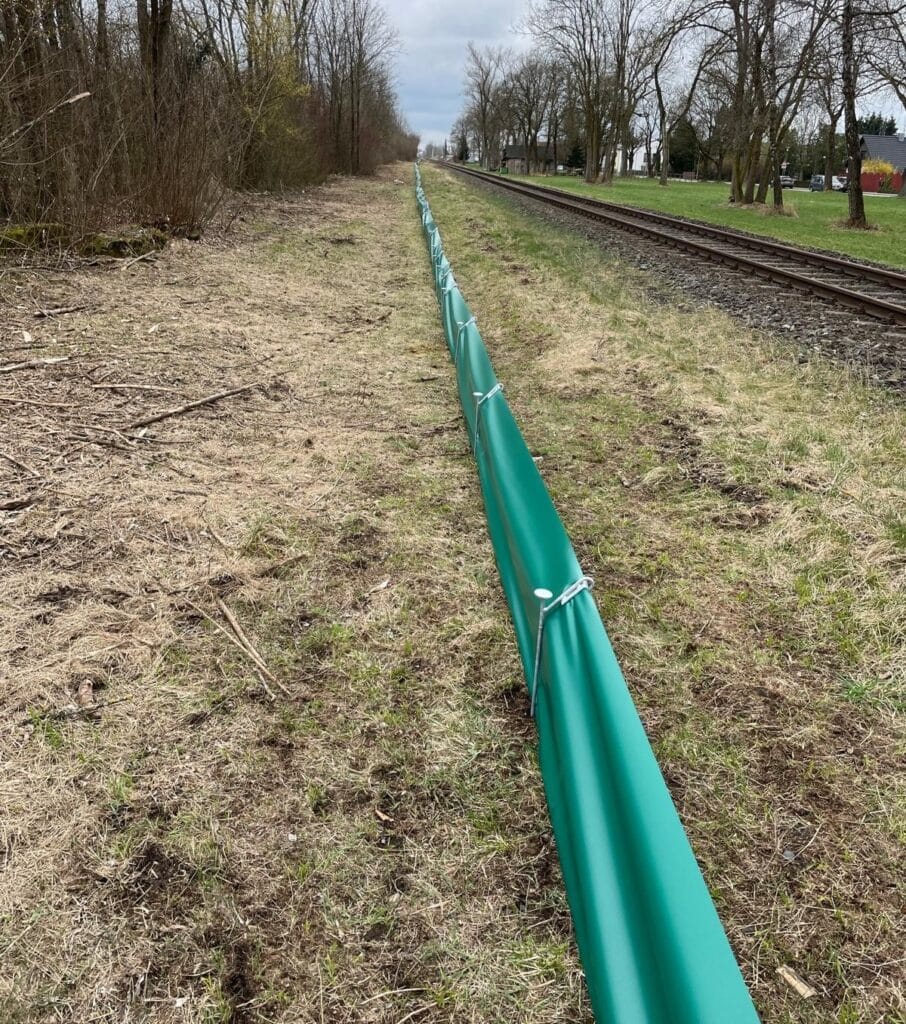
Made of a coated fabric of about 550 g/m², the robust fence combines a polyester carrier fabric with a PVC coating. As a result, the sheeting is tear-resistant and opaque, prevents vegetation from growing through and blocks the glare of headlights. Thanks to its high UV and weather resistance, it is suitable for repeated installation and removal as well as for long-term use. To hold the sheeting, double-rod posts use a special clamping wedge, while eyelets every 75 cm allow attachment to an existing fence with a PE-coated steel cable. Of the fence height, 10 cm can be buried or fixed to the ground.
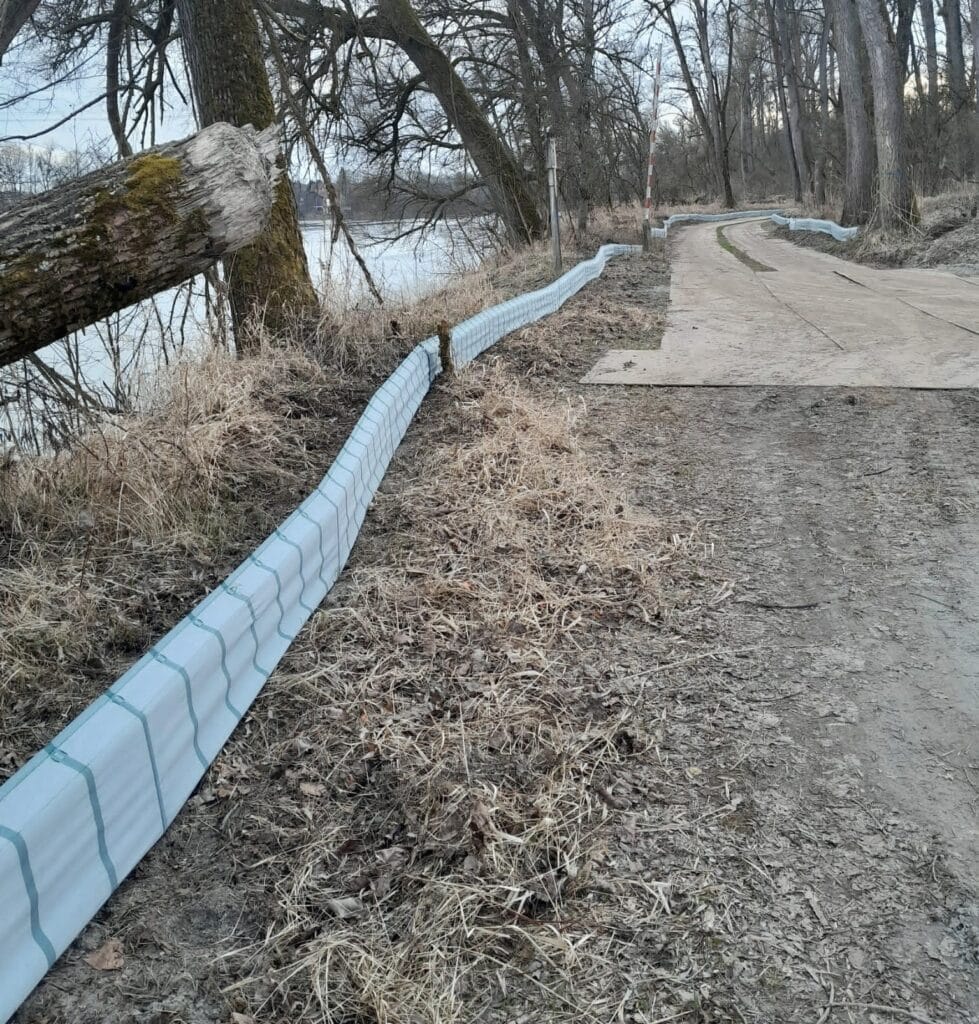
For simpler applications, the light fence consists of a woven fabric made of polyester and polypropylene yarn. This opaque fabric is UV-stable and weatherproof, so it withstands outdoor exposure throughout the migration season. Integrated pockets every 25 cm take the posts, which keeps installation simple. At the bottom, the skirt can either be buried about 7 cm deep or fixed with our ground anchors.
Typically, temporary amphibian fences run along roads and paths where animals cross on their way to their breeding ponds. On construction sites, the fence keeps amphibians and reptiles out of working areas. Fencing of this kind is widely used in wildlife mitigation, for example where great crested newts move between parts of their habitat. Until a permanent amphibian protection system is in place, the temporary fence serves as an interim solution. Later, permanent systems can be combined with crossings such as our stop drain and tunnel for small animals.
To make installation and daily handling easier, we supply accessories such as wooden gates for road crossings, pre-drilled pitfall buckets, an unrolling and rolling-up device and installation tools. Depending on the length and conditions of your section, we adapt the scope of delivery.
Ideally, planning starts in late autumn or early winter. In many regions, migration begins as early as February, depending on the weather, so the fence should be fully installed before the first mild, damp nights. Along the route, bends, junctions, drainage channels and embankments need special attention, because gaps often occur there.
Where burying is difficult, our ground anchors are the alternative: driven into the ground, they press the skirt down. Finally, place the pre-drilled pitfall buckets where helpers can reach them easily, since they need to be checked regularly throughout the season.
Wherever amphibians and reptiles cross roads or enter working areas, a mobile fence protects them during migration. We advise you on choosing between the robust and light version and on the accessories you need. We deliver to Great Britain and Ireland, and installation is carried out by you or by a contractor of your choice. Send us the length of your section and the intended fence height, and we will prepare a quote.

When planning an amphibian fence, the same questions come up again and again. Below, we answer the most important ones briefly.
Amphibian fencing is a barrier made of sheeting or fabric that is set up along roads or on construction sites. It keeps toads, frogs, newts and reptiles away from traffic and guides them to pitfall buckets or safe crossings.
The robust version is available for fence heights of 60, 70 and 80 cm, and up to 100 cm as a special production with longer lead times. The light version is available for 59 cm. In addition, an overhang angled at 45° at the top stops animals from climbing over the barrier.
The robust version is made of a PVC-coated polyester fabric of about 550 g/m² and is available for fence heights of 60, 70 and 80 cm, as a special production up to 100 cm. The light version consists of a woven fabric made of polyester and polypropylene yarn with a fence height of 59 cm. Both meet the criteria of M AQ 2022.
The fence is set up on the side from which the animals approach, with galvanised steel posts every 2 metres for the robust version and every 1.75 metres for the light version. At the bottom, the skirt is buried or fixed with ground anchors, three per 2 metres. Pitfall buckets along the fence collect the animals, and the fence should be complete before the migration season starts.
Yes, the robust version is suitable for repeated installation and removal as well as for long-term use thanks to its high UV and weather resistance. After the migration season, the fence is taken down and can be set up again the following year.
Yes, we deliver our amphibian fencing to Great Britain and Ireland. Installation is carried out by you or by a contractor of your choice, and we advise you on choosing the version and accessories.
We use third-party providers to ensure and improve the functionality of our services. You can choose which third-party providers you allow and save your selection or accept all.